Issue 1 · September 14, 2026
Five States
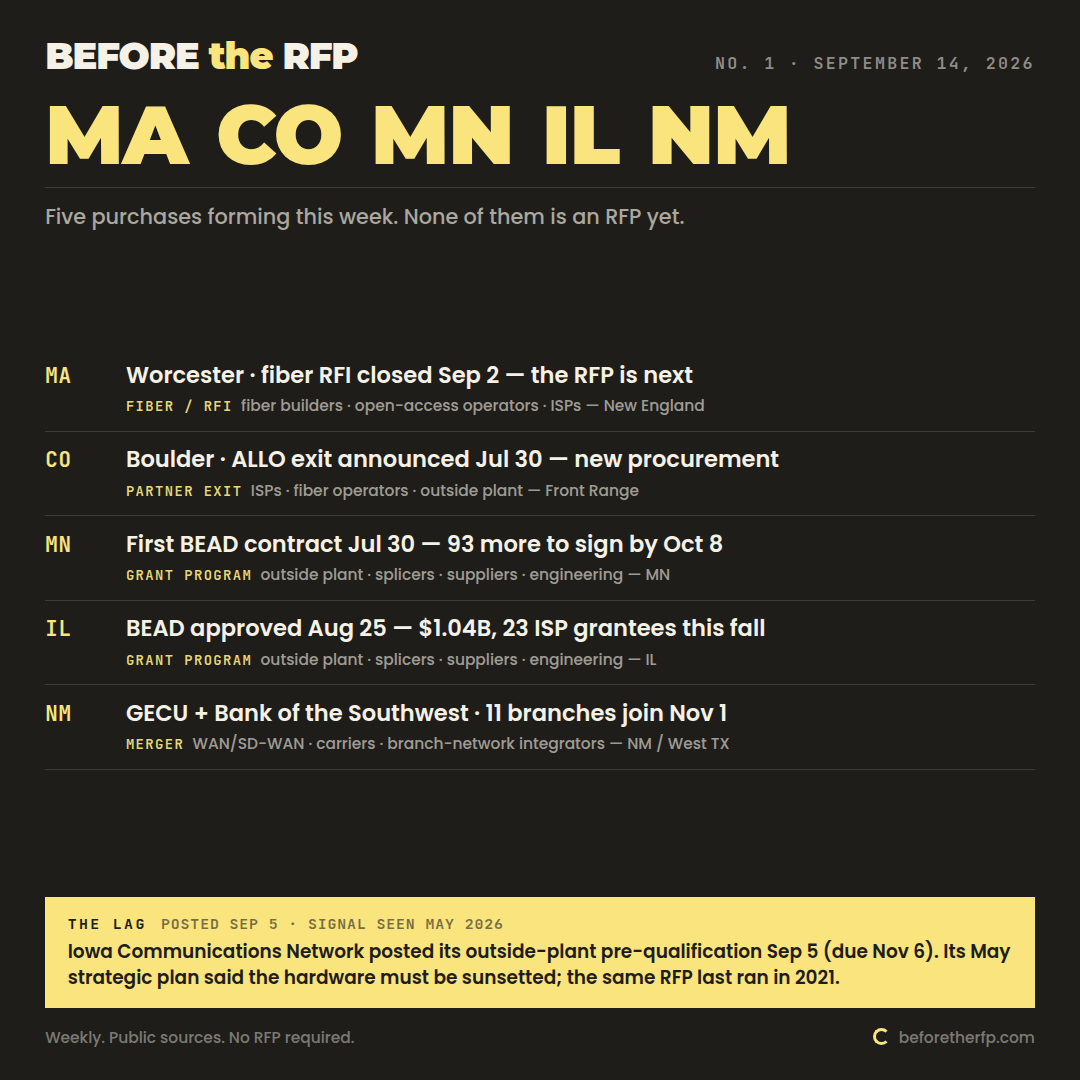
Five connectivity purchases forming right now. None of them is an RFP yet. Every one is public, and every one has a date.
FIVE FORMING
Worcester, Massachusetts
The city issued RFI-001, Fiber to the Premises Network, on July 30 and closed responses on September 2. An RFI is not a bid. It is the city asking the industry how a citywide fiber network should be built before it decides how to buy one. The answers shape the RFP that follows, and whoever helped write the question tends to be in the room for the answer.
Who should be watching: fiber network builders, open-access operators and ISPs in New England, and the engineering firms that design municipal networks. Watch the city's purchasing page. The RFP is the next public event.
Source: City of Worcester, RFI-001 Fiber to the Premises Network (open Jul 30, closed Sep 2): https://www.worcesterma.gov/finance/purchasing-bids/bids/rfi-001
Boulder, Colorado
ALLO Communications told the city in a July 10 email that it is pulling out of the 2025 lease agreement to build out Boulder's fiber network, and the city announced it on July 30. The city-owned backbone is around 65 miles of fiber, cost around $20 million, and was completed in 2024. The full network ALLO was to build would have spanned around 300 miles, reaching 80 percent of the city by 2028 and 97 percent by 2030. The city says it will "identify a new partner through a new procurement process" while exploring its legal options. A finished backbone with no partner is a purchase forming in public.
Who should be watching: ISPs and fiber operators along the Front Range who can lease a backbone and build the last mile, and outside-plant contractors who can do the roughly 300 miles ALLO was going to build. Watch the city's community broadband page and council agendas.
Sources: City of Boulder news release, Jul 30: https://bouldercolorado.gov/news/allo-communications-informs-city-it-will-pull-out-contract-build-out-fiber-network · Boulder Reporting Lab, Jul 30: https://boulderreportinglab.org/2026/07/30/allo-pulls-out-of-boulders-citywide-fiber-project-forcing-city-to-find-new-partner/
State of Minnesota
The Office of Broadband Development signed its first BEAD contract on July 30, with East Central Energy's fiber arm, for 3,750 locations between Minneapolis and Duluth. It has 93 more to sign by October 8. The full portfolio is 94 projects, 74,739 locations and about $569 million in federal and matching money. Every one of those contracts turns into construction, splicing, electronics and drop work that the grantee has to buy from someone.
Who should be watching: outside-plant contractors, splicers and materials suppliers across Minnesota and the neighbouring states, and the engineering firms that do environmental review and design for BEAD projects. The subgrantee list is public. The subcontracting is being decided now.
Source: Broadband Breakfast, "Minnesota's first BEAD contract lands", Jul 30: https://broadbandbreakfast.com/minnesotas-first-bead-contract-lands/
State of Illinois
On August 25 the NTIA approved Illinois's BEAD final proposal, the last of the 56 states and territories. $1.04 billion, more than 142,000 homes, businesses and anchor institutions, and 23 internet service provider grantees the Illinois Office of Broadband says it will formally on-board this fall. The Notice of Award starts a six-month clock to sign every grant agreement. After that, each grantee has to build, and building is where the subcontracting starts.
Who should be watching: outside-plant contractors, splicers, fiber and electronics suppliers, and engineering firms who can subcontract to the 23 grantees across Illinois. The grantee list is public. The subcontracting decisions come with the grant agreements.
Sources: Broadband Breakfast, "Illinois BEAD plan approved", Aug 25: https://broadbandbreakfast.com/illinois-bead-plan-approved/ · Illinois Office of Broadband announcement, Aug 25.
GECU and Bank of the Southwest, New Mexico
On August 27 GECU, the El Paso credit union, received regulatory approval to acquire Bank of the Southwest. The two combine on November 1 under the GECU name: 11 New Mexico branches, from Roswell to Farmington to Las Cruces, joining a $4.9 billion institution. Eleven branches changing owners on a known date is eleven sites that have to end up on one network and one carrier contract, and the integration plan gets written before the sign changes.
Who should be watching: WAN and SD-WAN providers, carriers with New Mexico and West Texas footprints, and network integrators who do branch consolidation for financial institutions. The window is between now and the integration that follows November 1.
Source: PR Newswire, Aug 27: https://www.prnewswire.com/news-releases/gecu-receives-regulatory-approval-to-acquire-bank-of-the-southwest-302862060.html
THE LAG
The Iowa Communications Network posted RFP 26-023 on September 5: pre-qualify vendors for telecommunications outside-plant services in five zones of the state, three vendors per zone, proposals due November 6. Nothing about it was a surprise. ICN's strategic plan, updated in May and public since, names "aging optical transport hardware" that has to be sunsetted and a network that needs constant, capital-intensive refreshes. And the last time ICN ran this exact solicitation was October 2021, as RFP 21-071, an annual contract with a pre-qualified bench. The plan said what the work was. The old RFP said how it would be bought. A contractor who read both had four months on everyone who waited for the posting.
Sources: ICN RFP 26-023 (due Nov 6, 3:00 pm): https://icn.iowa.gov/media/1018/download?inline · ICN Strategic Plan FY2026–2028 (updated May 2026): https://dom.iowa.gov/media/550/download?inline= · the 2021 edition, RFP 21-071: https://bidopportunities.iowa.gov/Home/GetBidOpportunityDocument/4a270e11-a4f1-4418-913f-e559c7976e3f
PATTERN
Every one of these five was decided in a room before it will ever reach a bid board - and three of them already have the date on a calendar. That is the whole thesis: the RFP is the receipt, not the decision.