Issue 2 · September 22, 2026
Five States
Correction, October 26, 2026
The first version of this issue ran a 2024 story as entry 2. Every figure in it was right; the year was two years off. It has been replaced with Harpers Ferry, Iowa, from a signed municipal record. Three smaller fixes: Indiana awarded the Paulding Putnam grant on July 22, not September 9; the seller in entry 4 is First Bank; and Centralia's target now reads "by December 31," as the source gives it.
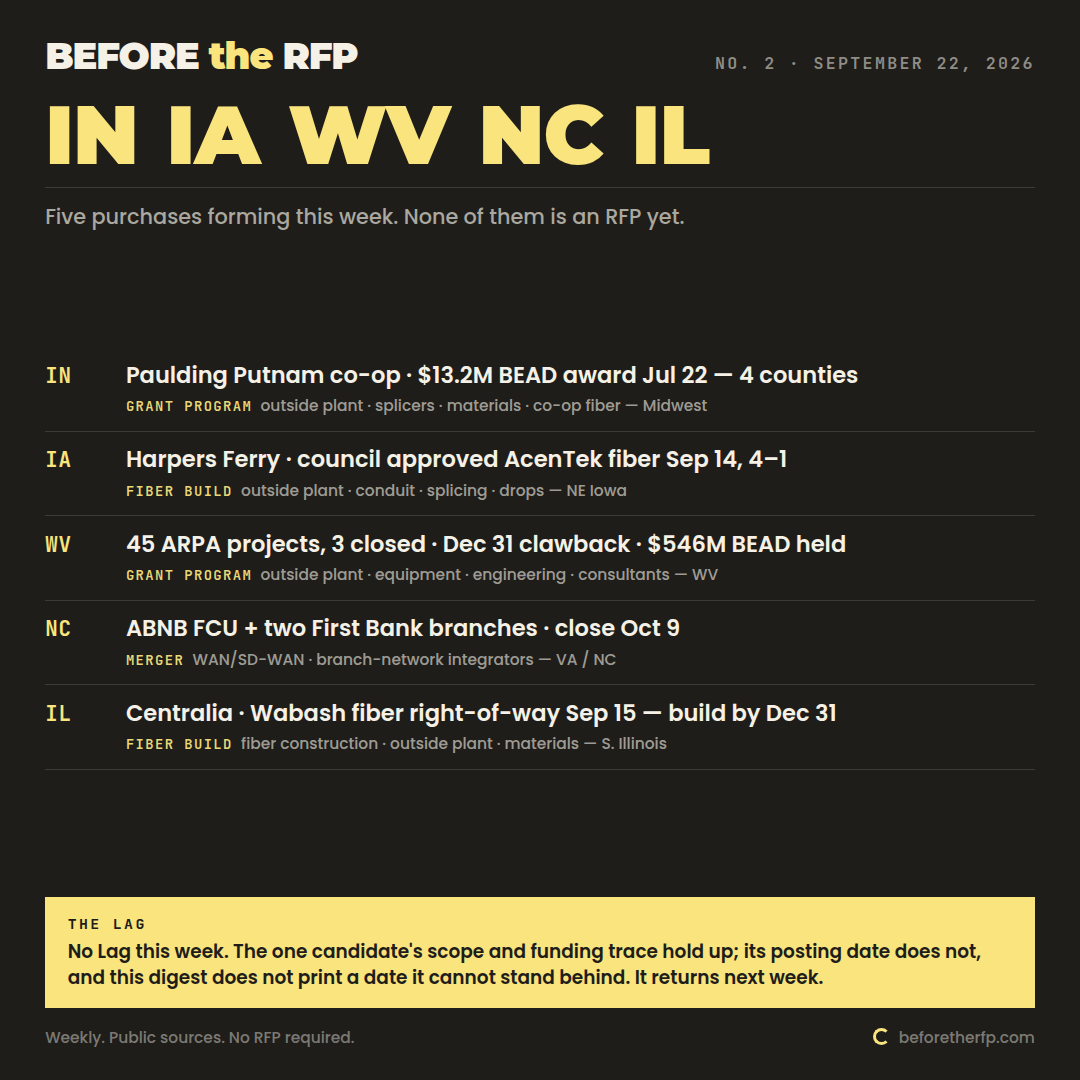
Five connectivity purchases forming right now. None of them is an RFP yet. Every one is public, and every one has a date.
FIVE FORMING
Paulding Putnam Electric Cooperative, Indiana
On July 22 the Indiana Broadband Office awarded Paulding Putnam Electric Cooperative $13,174,476 in BEAD funding, matched by $10,350,060 of cooperative investment, for unserved segments of Allen, Adams, DeKalb and Noble counties.
A BEAD award is not the end of a process. It is the start of one: the grant agreement gets signed, and then the co-op's fiber arm has to buy the build - outside-plant construction, splicing, cable and materials. Electric cooperatives put most of that work out rather than carrying the crews in-house.
Four counties are named in the award. The route is roughly known before a single contract is let.
Who should be watching: fiber construction and splicing contractors, materials suppliers, and the vendors who serve electric-cooperative fiber arms across the Midwest. Watch the Indiana Broadband Office subgrantee portal. The buying starts when the grant agreement is signed.
Source: Indiana Electric Cooperatives, July 22, 2026: https://indianaec.org/2026/07/22/electric-cooperatives-first-to-receive-bead-funding/
Harpers Ferry, Iowa
The Harpers Ferry city council met on Monday, September 14, 2026 and approved AcenTek to install fiber optic cable, on a roll call of four ayes to one nay. The same motion set a pre-construction meeting with AcenTek for 10:30 a.m. on Wednesday, September 16 - two days later - and the minutes record that "the public is welcome to attend."
Be precise about who is buying. The city approved AcenTek to install; it is not awarding a contract and there is no solicitation anywhere in this. The work that follows - boring and trenching, conduit, splicing and termination, restoration and right-of-way, traffic control, locating, drops - is bought by AcenTek, and the pre-construction meeting is where that sequence gets set.
Vote on Monday, pre-construction on Wednesday. No dollar figure appears anywhere in the record, and none is invented here.
Who should be watching: outside-plant fiber construction, splicing and restoration contractors in northeast Iowa, and anyone already subcontracting to AcenTek. Watch the city's agendas and minutes page - and watch AcenTek rather than the city, because the city's role in this one ends at the approval.
Source: City of Harpers Ferry, adopted minutes of the September 14, 2026 regular council meeting, signed by Mayor Jerry Valley and City Clerk Kelli Melcher: http://harpersferryiowa.com/wp-content/uploads/2026/09/September-14-2026-Minutes.pdf
State of West Virginia
At its monthly meeting, reported September 10, the West Virginia Broadband Enhancement Council recorded 45 active ARPA-funded projects with only 3 closed out, against a federal clawback deadline of December 31, 2026. Separately, the state's BEAD money - $546 million of the $1.2 billion approved - is waiting behind NEPA environmental review.
That is two clocks on one buyer, running in opposite directions.
The ARPA clock is the urgent one. Money that is not spent by December 31 goes back, and 42 projects that are open with a quarter to go is a state that has to compress construction, equipment and close-out work into the weeks it has left. Compressed schedules get bought quickly and they get bought from whoever can start.
The BEAD clock is the slow one, and it is the bigger number. When the environmental review clears, $546 million turns into subgrant agreements, and subgrant agreements turn into construction bids. Nobody gets to schedule that, which is exactly why it is worth watching the review rather than the bid board.
Who should be watching: outside-plant contractors and equipment suppliers who can absorb rush West Virginia work before December 31, and the engineering and grant consultants tracking the NEPA clearance. Watch the Council's public meeting materials and the state's subgrantee announcements.
Source: Weirton Daily Times, "W.Va. Broadband Enhancement Council receives updates on BEAD, ARPA projects", Sep 10, 2026: https://www.weirtondailytimes.com/news/local-news/2026/09/w-va-broadband-enhancement-council-receives-updates-on-bead-arpa-projects/
ABNB Federal Credit Union, North Carolina
Trade press reported on September 14 that ABNB Federal Credit Union has the regulatory approvals it needs - from the NCUA and the FDIC - to acquire two First Bank branches, in Roanoke Rapids and Louisburg, North Carolina. The deal is set to close October 9.
Two branches is a small number and a clean shape. Branches join a new owner on a known date, which means they end up on one network and one carrier contract, and the integration plan gets written before the sign changes. Circuits, firewalls, the branch WAN, the connection back to the acquirer's core - all of that has to be ordered ahead of a close date, not after it.
The close is October 9. The work that follows it is being planned now.
Who should be watching: WAN and SD-WAN providers and network integrators who do branch consolidation for financial institutions in Virginia and North Carolina. There is no public procurement vehicle here - this is a private integration, bought on relationships and speed. The window is now through the fourth quarter.
Source: The CU Daily, "ABNB FCU gets regulatory OK to acquire 2 bank branches", Sep 14, 2026: https://thecudaily.com/abnb-fcu-gets-regulatory-ok-to-acquire-2-bank-branches/ (trade-press reporting of the regulatory action; the NCUA and FDIC orders themselves are not linked here)
Centralia, Illinois
The Centralia City Council approved a right-of-way license agreement letting Wabash Communications install fiber optic cable citywide, reported September 15, with installation targeted for completion by December 31.
The right-of-way is the last administrative step before a build. Construction permits come next, and the city is on record engineering and inspecting the build alongside Wabash, which means the permitting is a sequence and not a question.
Approval to shovels inside one quarter, in a city that has already said yes.
Who should be watching: fiber construction and outside-plant contractors and materials suppliers in south-central Illinois. Watch the City of Centralia permit office - the permits are the public trace of who is actually doing the work. The December 31 target is the schedule everyone downstream has to hit.
Source: Southern Illinois Now, "Centralia approves right-of-way for Wabash Communications fiber", Sep 15, 2026: https://southernillinoisnow.com/2026/09/15/centralia-approves-right-of-way-for-wabash-communications-fiber/
THE LAG
There is no Lag this week.
There was one candidate. Its scope and its funding trace both hold up. Its posting date does not: the city's own link to the solicitation returns a 404, and the procurement portal that carries it would not render its open-opportunities list. The date was checked twice and is still unconfirmed.
The Lag's entire claim is a date. This posted on a day you can name, here is the public document that said it was coming, months earlier, and here is the gap between them. Without the posting date there is no gap, only an interesting document.
A digest that tells you every line carries a date does not print a date it cannot stand behind. That standard is the product, and it applies here first.
The Lag returns next week.
PATTERN
This week's five are not decisions waiting to be made. They are decisions already made, with the money attached and a deadline somebody else has to hit. Three of the five have to close or be built before December 31.
Also on LinkedIn: the newsletter issue